Termites in Fairfax, VA: Inspections, Treatment and Local Help
Fairfax County has the same spring termite as the rest of Virginia, plus two local wrinkles: a lot of shared walls, and a band of clay soil that cracks foundations. Here's what that means for your house.
The short version
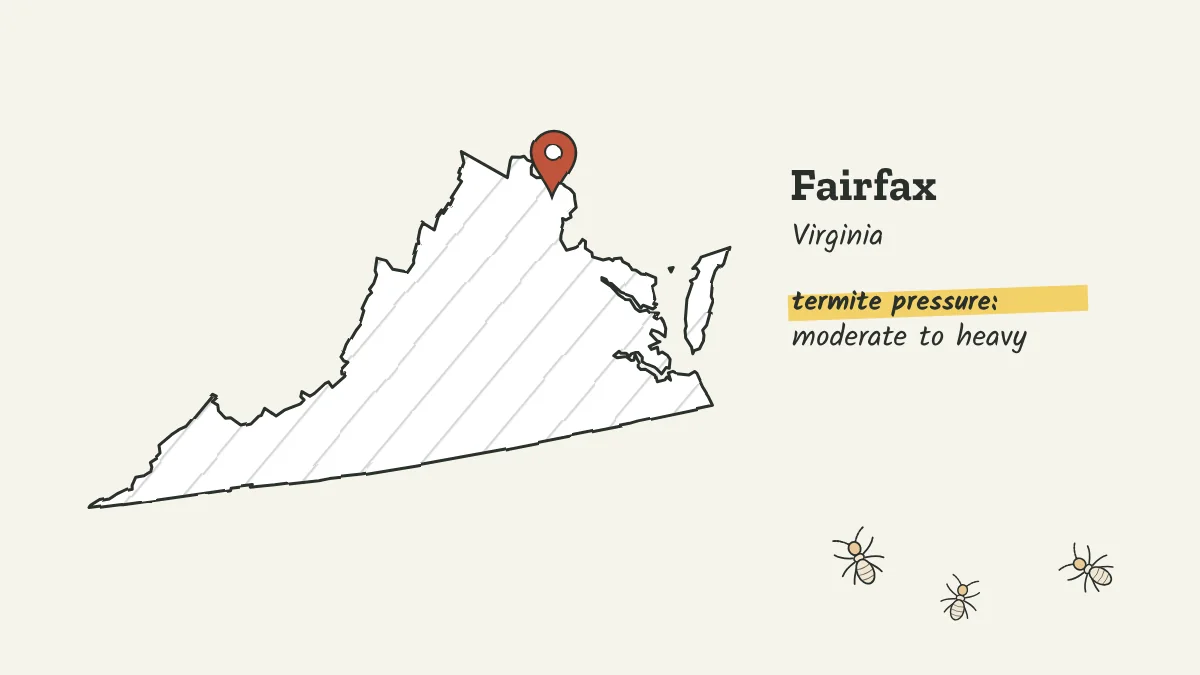
Fairfax has moderate to heavy termite pressure from the eastern subterranean termite, which swarms in daylight from March through May. Watch finished basements, shared townhouse foundations and any foundation cracks, especially on the marine clay soils in the southeast of the county. Termite companies must hold a Virginia VDACS pesticide business license.
Fairfax at a glance
- Termite pressure
- Moderate to heavy
- Termites to know
- Eastern subterranean
- Why termites like it here
- Humid summers, wooded lots, finished basements, and marine clay in the southeast of the county that cracks foundations and drains slowly.
- Who licenses pest control
-
Virginia Department of Agriculture and Consumer Services, Office of Pesticide Services
Check a company's license - Inspection report for home sales
- A wood-destroying insect report, usually the NPMA-33, chosen by the buyer in the purchase contract
On this page
Fairfax's termite
The termite you'll meet here is the eastern subterranean termite, Virginia's most common and most destructive species. It nests in the soil, reaches wood through mud tubes, and needs moisture. Virginia Tech's extension entomologists put the state's swarm season at March through May, in daylight, often after a warm rain, with swarmers heading for windows because they're drawn to light.
The Fairfax County Master Gardeners, trained through Virginia Cooperative Extension, say colonies can reach up to a million termites with nests deep underground, and point to wood touching soil, moisture problems and wood debris as the usual invitations: raised beds, fences, decks, porches and sheds.
For the full species profile and swarm calendar, see the Virginia termite guide.
Fairfax County by the numbers
Termite risk follows housing. Fairfax County's own demographic report shows how much of it shares walls.
| Housing type | Units | Share |
|---|---|---|
| Single-family detached | 196,663 | 46.1% |
| Single-family attached (townhouses, duplexes, multiplexes) | 103,369 | 24.2% |
| Multifamily | 126,380 | 29.6% |
| Total | 426,412 | 100% |
Source: Fairfax County Demographic Reports 2022. One in four homes here is attached housing, which changes how termite treatment and warranties should work.
Townhouses: treat the problem, not the property line
A subterranean colony forages through the soil wherever the food is. NC State's extension entomologists say workers regularly travel up to 200 feet from the nest. A row of townhouses on one continuous foundation looks like a single long buffet.
If you own an attached home:
- Tell your neighbors when you find termites. It's not embarrassing; it's useful.
- Ask the company what happens at the shared walls. A treatment that stops at your unit's edge leaves the colony next door with a path back.
- Check with your HOA. Some associations handle exterior pest control or have a preferred approach for the whole row. Ask before you sign your own contract.
- Read the warranty for language about adjoining units and re-infestation from neighboring property.
Marine clay: the local twist
Fairfax County's Land Development Services publishes a homeowner's guide to marine clay, a shrink-swell soil found on hilly land in the southeast of the county. Most of it lies in the Lee and Mount Vernon districts, with small areas in Mason, and the county says the clays underlie much of the land east of Interstate 95.
Here's why a termite site cares. When the clay dries, it shrinks and leaves gaps under footings; when it gets wet, it swells hard enough to push on basement walls. The result is cracked masonry, warped frames and foundation cracks that open in summer and close in winter. Every one of those cracks is a hidden route for termites, and because water percolates very slowly through the clay, the soil against the house stays damp.
The county's advice doubles as termite prevention:
- Slope the ground away from the house, at least 5 percent, or about six inches of drop over ten feet.
- Keep gutters and downspouts working and send roof water well away from the foundation.
- Don't leave hoses or outside faucets running.
- Keep large trees at least 20 feet from the house.
You can check the county soil maps for marine clay or Marumsco soils near your lot, and the Northern Virginia Soil and Water Conservation District (703-324-1460) can help read them.
A Fairfax spring checklist
-
Walk the foundation in early March
Before swarm season, look for mud tubes on foundation walls, piers, the garage wall and where pipes and wires enter. Our inspection walkthrough shows where to point the flashlight.
-
Check the finished basement
Look along baseboards and paneling on outside walls, under the stairs and around the sump. Finished basements hide tubes for years.
-
Pull the mulch back
Keep a strip of foundation visible and the soil below weep holes and siding. See does mulch attract termites.
-
Fix the water
Extend downspouts, clear gutters and fix grading, especially if you're on clay.
-
Get a professional look on schedule
The Fairfax County Master Gardeners suggest a professional termite inspection every two to three years. Get yearly ones if you've had termites before.
Hiring a termite company in Fairfax
Pesticide licensing in Fairfax County and the City of Fairfax is handled by the state, through the VDACS Office of Pesticide Services. Every company you call should have a Virginia pesticide business license and a certified applicator in category 7B, wood-destroying pest control.
Before you sign, check the company on the VDACS online services portal and the pesticide civil penalty search, get two or three written proposals, and compare what each one treats and warrants. Our guides to choosing a termite company and termite treatment costs show how to compare them. The Master Gardeners also suggest firms certified through the Virginia Pest Management Association.
Questions people ask
When do termites swarm in Fairfax, VA?
Mostly March through May, sometimes into June, usually in daylight on a warm day after rain. Swarmers gather at windows and doors because they're drawn to light.
Who licenses termite companies in Fairfax County?
The state does. The Virginia Department of Agriculture and Consumer Services, Office of Pesticide Services, licenses pesticide businesses and certifies applicators. Termite work falls under category 7B, wood-destroying pest control.
My townhouse neighbor has termites. Should I worry?
Yes, enough to get an inspection. Attached homes often share a continuous foundation, and subterranean termites forage well beyond one unit. Ask any company you hire how it handles the shared walls.
Does marine clay make termites worse?
Not directly, but it helps them. Fairfax County says marine clay shrinks and swells, cracking foundations, and drains slowly, keeping soil wet. Cracks and damp soil next to the house are exactly what subterranean termites use.
How often should I get a termite inspection in Fairfax?
The Fairfax County Master Gardeners suggest every two to three years. I'd go yearly if you've had termites before or live in an attached home.
More in Virginia
Keep reading
Sources
- Fairfax County Master Gardeners: Termites in Virginia, unseen but deadly
- Fairfax County Land Development Services: Homeowner's guide to marine clay
- Fairfax County Demographic Reports 2022
- Virginia Cooperative Extension: Subterranean termite biology and behavior (444-502)
- Virginia Cooperative Extension Fairfax County: Insect identification request form
- Virginia Department of Agriculture and Consumer Services: Pesticide business license
- Virginia Department of Agriculture and Consumer Services: Commercial applicator categories
- Virginia Code 55.1-703: Residential Property Disclosure Act
- Doug Francis, Northern Virginia real estate: Termite inspections in Virginia contracts
- NC State Extension: Biology and behavior of eastern subterranean termites