How to Choose a Termite Company Without Getting Burned
The best termite company is rarely the one that knocks first or talks fastest. It's the one whose written proposal still makes sense when you lay it next to two others.
The short version
Choose a termite company by checking its state license first, then getting two or three inspections and written proposals. Compare the treatment method, the product and concentration, a diagram of what will be treated, the warranty type, renewal cost and what voids it. Walk away from pressure to sign today, vague verbal quotes and anyone who won't show a license.
On this page
You almost always have time
Termites are slow on a human scale. NC State's extension entomologists estimate that a colony of about 60,000 termites eats roughly a foot of 2x4 in about five months. That's real damage over years, not over a weekend.
So unless you're closing on a house next week, there's no emergency that justifies skipping comparison shopping. The U.S. EPA's own advice for choosing a pest control company is to get bids from two or three companies and weigh value, not just price.
How to choose, start to finish
-
Confirm it's termites
Flying ants fool everyone. Snap a photo or take the termite or flying ant quiz before anyone gets in your crawlspace.
-
Check licenses before you call
Every state licenses companies that do termite work, usually through the department of agriculture. Look the company up and check its complaint and penalty history. Our guide to checking a pest control license links each state's lookup.
-
Book two or three inspections
Ask each company to inspect, explain what it found and show you the evidence: mud tubes, damage, droppings. A good inspector is happy to point a flashlight at it with you. Many companies inspect for free, and there's a guide on whether free inspections are really free.
-
Get every proposal in writing
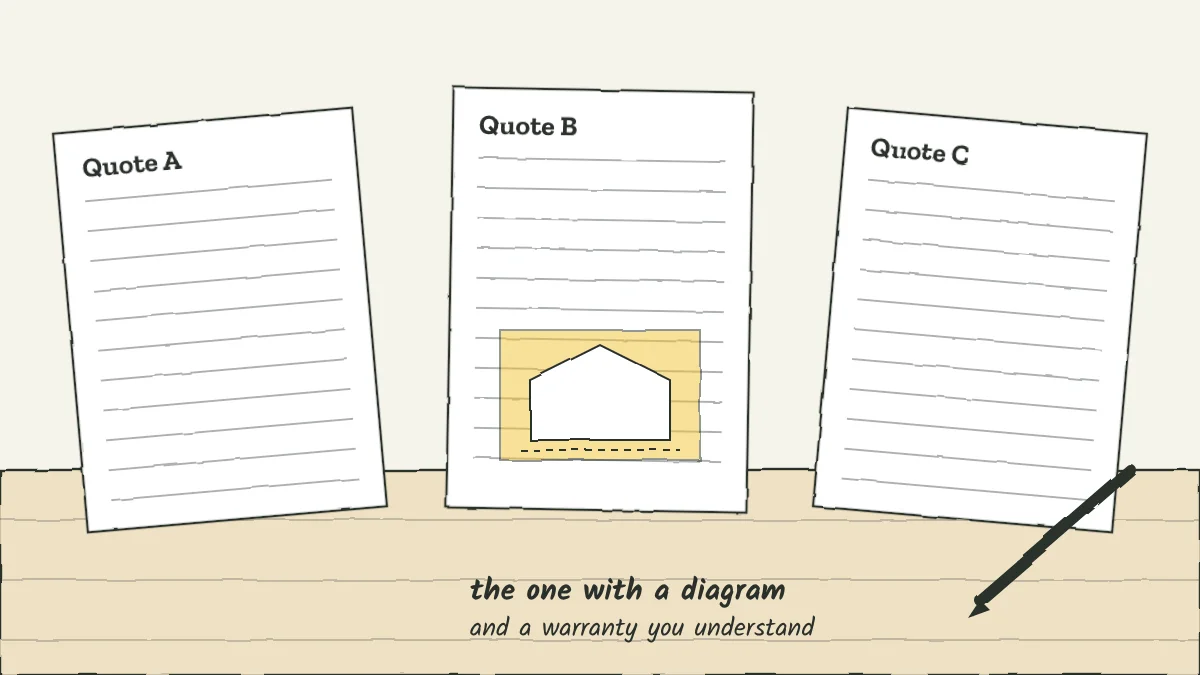
A real proposal has a diagram of your house, the product and its concentration, what will be treated, the price and the warranty terms. A number scribbled on a business card is not a proposal.
-
Compare them side by side
Use the checklist below. Differences in price usually come from differences in what's treated or what's warranted.
-
Ask your questions, then sign
Our list of questions to ask a termite company covers the details. Keep a copy of everything you sign, plus the label.
What a good proposal includes
Texas requires most of this in writing before any termite treatment, by state rule. Wherever you live, it's the right list to hold every company to.
| Item | Why it matters |
|---|---|
| Company name, address, phone and state license number | So you can look them up, and complain if needed |
| Diagram of the house | Shows active termites, past damage, areas to be treated and conducive conditions |
| Treatment type | Full, partial, spot, bait or fumigation, defined in plain words |
| Product label and concentration | Lets you compare products honestly. See our Termidor SC review |
| Number of bait stations, if baiting | "Some stations" can mean anything |
| Price, and what it includes | Drilling slabs and porches is often the difference between quotes |
| Warranty: length, repair or retreatment, renewal cost | The part that costs the most over ten years |
| What voids the warranty | Remodeling, wood-to-soil contact and missed renewals are common conditions |
| Who to contact at the state agency | A legitimate company has nothing to hide here |
Comparing three quotes
Here's a made-up example of three proposals for the same 200-foot foundation. The cheapest one is cheapest for a reason.
| Item | Company A | Company B | Company C |
|---|---|---|---|
| First-year price | $1,350 | $1,900 | $2,400 |
| Method | Repellent liquid | Non-repellent liquid | Bait system |
| Garage and porch slabs drilled | No | Yes | Not needed |
| Diagram provided | No | Yes | Yes |
| Warranty | Retreatment only, 1 year | Retreatment and repair | Retreatment and repair |
| Yearly renewal | $350 | $300 | $400, includes monitoring |
Company B is my pick here: complete coverage, a repair warranty and a reasonable renewal. Company A skipped the slabs, which is where termites often get in. Real price ranges are in termite treatment costs.
Red flags and green flags
Do
- Shows you the evidence and explains what it means
- Leaves a written proposal and gives you time to think
- Hands over the product label and safety data sheet when asked
- Explains what voids the warranty without being asked twice
- Carries insurance and can show proof on paper, as the EPA recommends you ask
Don't
- Pressure to sign today, or a discount that expires when the truck leaves
- A verbal quote only, or a price with no diagram
- Can't or won't show a state license
- Finds termites but can't show you where
- Wants to retreat every year without evidence of new activity. In Texas that's not allowed by rule
- Your only information about the company comes from its own salesperson, a warning sign the EPA calls out specifically
Big company or small one?
I get asked this a lot, and the honest answer is that it doesn't matter as much as people think. Big companies tend to have more uniform contracts and longer track records with warranties. Small local outfits sometimes give you the owner's cell number and more careful work. Both can be excellent, and both can send a rushed technician.
Judge the proposal, the inspection and the warranty, not the logo on the truck. The EPA also suggests asking neighbors and friends about their experience and checking your state or local pesticide agency for complaints. Membership in a professional association, such as a state pest management association, is a good sign of attention to training, though it's no guarantee.
Warranties decide the real price
The first-year treatment price gets all the attention. The warranty, and what it costs to keep it, matter more over ten years.
- Retreatment-only warranties pay to treat again if termites come back. Damage is your problem.
- Repair warranties also pay for new damage, up to a limit. They cost more and are worth it in heavy-pressure areas.
- Renewal fees keep the warranty alive year after year. Miss one and you may lose coverage.
- Transferability matters if you might sell. See transferring a termite bond.
There's a full breakdown in repair vs. retreatment warranties and in our guide to the termite bond.
Questions people ask
How do I choose a good termite company?
Check that it's licensed by your state, get inspections and written proposals from two or three companies, and compare the treatment, the product, a diagram of what's treated and the warranty terms. Choose on value and completeness, not just the lowest price.
How many termite quotes should I get?
Two or three is the usual advice, and it's what the EPA recommends for pest control in general. More than that rarely adds much. Fewer than two leaves you with nothing to compare.
Are national termite companies better than local ones?
Not automatically. Large companies may have more uniform contracts, and local companies may give more personal service. Compare the written proposals and warranties rather than the company size.
Why are termite quotes so different?
Usually because they treat different things or warrant different things. One quote may skip drilling the garage slab, use a repellent product, or cover retreatment only. Line them up item by item and the gap usually explains itself.
How can I check complaints against a termite company?
Contact your state's pesticide regulatory agency, which licenses pest control companies and investigates complaints. Some states also publish penalty records online, such as Virginia's pesticide civil penalty search.
Keep reading
Termites in your state
Sources
- U.S. EPA: Tips for choosing a pest control company
- U.S. EPA: Termites, how to identify and control them
- Texas Administrative Code, 4 TAC 7.174: Wood destroying insect treatment disclosure documents
- Texas Department of Agriculture: Termite FAQs
- NC State Extension: Biology and behavior of eastern subterranean termites
- Virginia Department of Agriculture and Consumer Services: Pesticide civil penalty search