Termidor SC Review: What It Does and Who Should Use It
Termidor SC is the termite treatment you'll hear about most often, from neighbors and from quotes. It earns most of its reputation. The part about one termite killing the whole colony deserves a closer look.
The short version
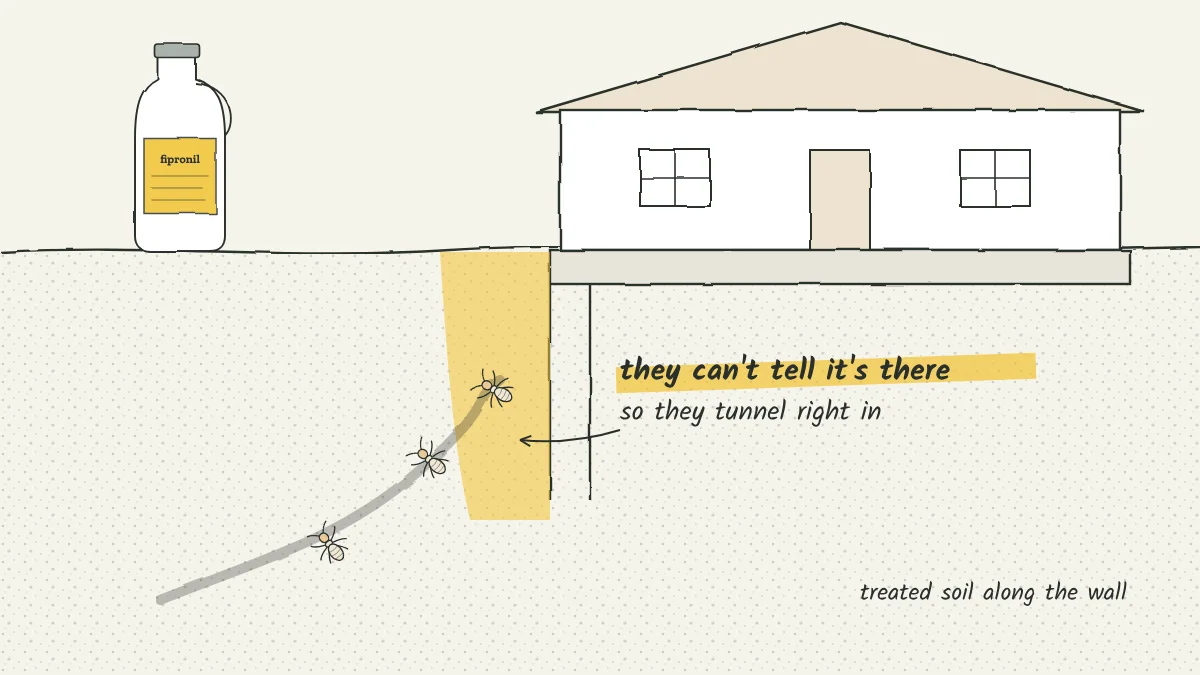
Termidor SC is a 9.1 percent fipronil termiticide that licensed applicators dilute and put into the soil around a foundation. It's non-repellent, so termites tunnel into treated soil without noticing and die. It's a strong, well-tested choice for subterranean termites, typically protecting for about five years or more, but only when it's applied thoroughly by a licensed professional.
On this page
Termidor SC at a glance
Everything below comes from the product's EPA-accepted label unless noted.
| Item | What the label says |
|---|---|
| EPA registration | 7969-210 |
| Active ingredient | Fipronil, 9.1 percent |
| Termite dilutions | 0.06, 0.09 or 0.125 percent finished dilution |
| Termites on the label | Subterranean, arboreal, drywood and dampwood |
| Other pests on the label | Several ants, including carpenter, Argentine, odorous and pavement ants |
| Application | Mostly conventional liquid: at least 75 percent of the finished dilution must go on that way. Foam is allowed in wall voids and similar spots |
| Who may use it | Only individuals or firms licensed or registered by the state |
| Water rules | Never within 5 feet of a well or cistern |
The label doesn't classify Termidor SC as a federal Restricted Use Pesticide, but the licensed-applicator line limits who can buy and use it. More in can anyone buy Termidor.
How it works on termites
Older termite treatments were repellent. They made a chemical wall termites could sense and avoid. The weakness of any wall is the gap: miss a spot behind the porch steps and the termites find it.
Fipronil is non-repellent. The University of California's IPM program lists fipronil, imidacloprid and chlorantraniliprole as non-repellent to termites, and contrasts them with pyrethroids, which termites detect and avoid. Termites foraging through treated soil don't know it's treated. They pick up the active ingredient, and it acts slowly enough that they keep moving and working for a while before they die.
That delay is the clever part. A gap in a non-repellent treatment is still a problem, but the soil around the gap is a trap rather than a fence.
How long it lasts
Every liquid termiticide registered in the U.S. has to pass long-term USDA Forest Service field tests, and under EPA guidelines it must give complete control for five years at each test site. Texas A&M AgriLife Extension puts the protection from modern liquid termiticides at about five years.
In real houses, the treatment usually lasts until something disturbs the treated soil: a new patio, a plumbing repair through the slab, a raised flower bed, years of erosion from a gutter that dumps at the wall. The full story, with what cuts protection short, is in how long termite treatment lasts.
Termidor compared with the other options
Termidor isn't the only good answer. Here's how it sits next to the alternatives a company might offer.
| Option | How it works | Where it fits |
|---|---|---|
| Termidor SC (fipronil) | Non-repellent liquid in the soil | Subterranean termites, most houses, often the default quote |
| Other non-repellent liquids (imidacloprid, chlorantraniliprole) | Non-repellent liquid in the soil | Same jobs. Compare the concentration and warranty, not the brand |
| Repellent liquids (pyrethroids such as bifenthrin) | A barrier termites detect and avoid | Often cheaper. Gaps in coverage matter more |
| Bait systems | Workers eat a slow-acting bait and share it with the colony | Where drilling slabs is a problem, or you prefer less pesticide in the soil. See Sentricon vs Termidor |
| Fumigation or heat | Kills drywood termites inside the structure | Drywood colonies throughout the house. See termite tenting |
For drywood termites, Termidor can be used as a local wood treatment, but whole-house infestations usually call for fumigation or heat.
What I like, and what I don't
- Well tested: Fipronil has years of federal field testing and university research behind it.
- Non-repellent: Small gaps don't turn into termite highways the way they can with a repellent product.
- Low rates: The finished dilution in the soil is a fraction of a percent.
- Flexible: The same product covers liquid, foam and some wood treatments.
- Not a DIY product: The label limits it to licensed or registered applicators, and the job needs trenching, rodding and drilling.
- Only as good as the application: A rushed job with skipped spots behind steps, under porches or along the garage is still a weak job.
- The "colony elimination" pitch is oversold: See the research above.
- Brand isn't the whole price: Generic fipronil and other non-repellents can do the same job. Ask what the warranty covers.
Is it safe?
Termidor's label keeps people and pets out of treated areas until sprays have dried, forbids treatment within 5 feet of a well or cistern, and limits use to licensed applicators. The National Pesticide Information Center notes that fipronil binds tightly to soil once it's in place. If you have kids, pets, a well or a vegetable garden along the house, read our full guide to how safe Termidor is before treatment day.
What to ask before you sign
-
Which product, and at what concentration?
The label allows 0.06, 0.09 or 0.125 percent. Ask which one they'll use and why. A higher rate isn't automatically better, but you should know what you're buying.
-
Full or partial treatment?
A full treatment covers the whole foundation perimeter, plus drilling through slabs and porches where needed. A partial or spot treatment covers only some areas. In Texas, companies must define these terms in writing before treating. Wherever you live, ask for a diagram.
-
What about the garage, porches and patios?
These are the spots skipped most often, because they need drilling. Ask how they'll treat soil under each one.
-
What does the warranty cover?
Retreatment only, or repair of new damage too? How long, what does renewal cost, and what voids it? Our guide to repair vs. retreatment warranties explains the difference.
-
Can I see the label?
Any licensed applicator can give you the label and the safety data sheet. The EPA recommends asking to see them.
Questions people ask
Is Termidor the best termite treatment?
It's one of the best-tested liquid treatments for subterranean termites, and a thorough Termidor job is a strong choice. Other non-repellent products and bait systems also work well. The quality of the application and the warranty matter as much as the product.
How long does Termidor last?
Modern liquid termiticides typically protect for about five years or more, and must pass five-year federal field tests to be registered. Digging, new concrete and erosion near the foundation can shorten that.
Can I buy Termidor SC and apply it myself?
Not legally, unless you hold a state applicator license. The label reserves the product for licensed or registered professionals, so an online listing doesn't make home use allowed. The details are in can anyone buy Termidor.
Does Termidor kill the termite colony?
It kills the termites that forage into treated soil, which can collapse the part of the colony attacking your house. Research suggests termite-to-termite transfer plays only a small role in the field, so it isn't a guaranteed colony killer. Bait systems are designed for that job.
How much does a Termidor treatment cost?
It's priced like other liquid soil treatments, usually by the linear foot of foundation, plus drilling. See our termite treatment cost guide for typical ranges and how to read a quote.
Keep reading
Termites in your state
Sources
- U.S. EPA: Termidor SC product label (EPA Reg. No. 7969-210)
- University of California IPM: Pest Notes, Termites
- Saran and Rust, Toxicity, uptake and transfer efficiency of fipronil in western subterranean termite, Journal of Economic Entomology, 2007
- Texas A&M AgriLife Extension: Subterranean termites (E-368)
- National Pesticide Information Center: Fipronil general fact sheet
- Texas Administrative Code, 4 TAC 7.174: Wood destroying insect treatment disclosure documents
- U.S. EPA: Termites, how to identify and control them