Can Anyone Buy Termidor? What the Label and the Law Say
You can find Termidor for sale online in about ten seconds. The label on the bottle says something different about who's allowed to use it, and the label is the part that counts.
The short version
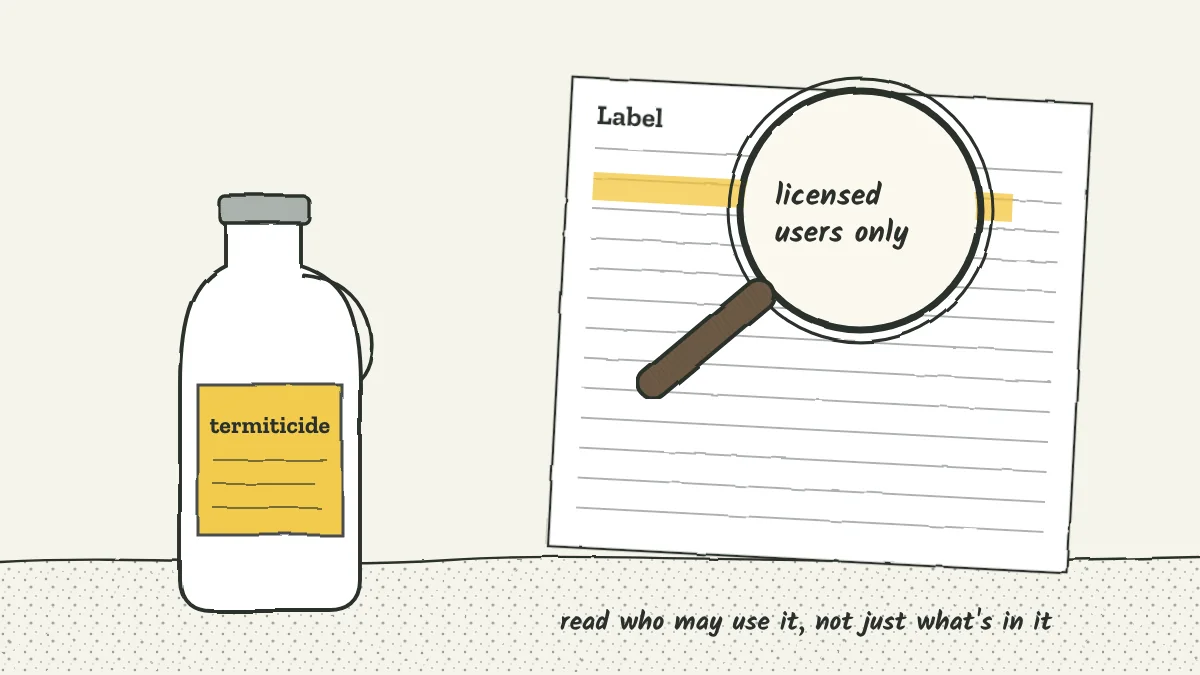
Not legally, unless you're licensed. Termidor SC's label says it's for sale to, use and storage only by individuals or firms licensed or registered by the state to apply termiticides or general pest control products. Online sellers may still ship it, but buying it doesn't make using it legal. Homeowners who aren't licensed should hire a licensed applicator.
On this page
What the label actually says
Termidor SC (EPA Reg. No. 7969-210) is a 9.1 percent fipronil concentrate. Near the top of its EPA-accepted label is this line:
"For sale to, use and storage only by individuals/firms licensed or registered by the state to apply termiticide and/or general pest control products."
That one sentence answers most of the question. It doesn't say "recommended for professionals." It limits sale, use and storage to people with a state license or registration.
Pesticide labels in the U.S. aren't suggestions. The National Pesticide Information Center puts it bluntly: don't use pesticides in any manner other than those specifically listed on the label, because it's against the law. A use the label doesn't allow is a misuse, whoever sold you the product.
Three kinds of "restricted"
People use "restricted" loosely, which causes most of the confusion about Termidor. Here's how the categories actually work.
| Category | Who can use it | Example |
|---|---|---|
| General use | Anyone, following the label | Most garden-center bug sprays |
| Restricted Use Pesticide (federal RUP) | Certified applicators, or people under their supervision | Many fumigants |
| Label restricted to licensed applicators | Only people licensed or registered by the state, per the label | Termidor SC |
Termidor SC's label doesn't classify it as a federal Restricted Use Pesticide. It doesn't need to. The licensed-applicator line on the label does the restricting on its own.
So why is it for sale online?
Because a listing is just a listing. Plenty of online sellers carry professional products, and selling a product isn't the same as authorizing a use. If you're licensed, buying online is ordinary business. If you're not, the label still applies to you the moment you open the bottle.
In practice, enforcement happens at the state level. Every state has a pesticide regulatory agency, usually inside the department of agriculture, that licenses applicators and investigates misuse. The U.S. EPA tells homeowners to contact that agency with concerns, and that's who would hear about a botched DIY job that reached a neighbor's well. We explain how the system fits together in how termiticides are regulated.
How a few states handle termite work
The license names and rules differ by state. These examples show the pattern.
| State | Who licenses | What stands out |
|---|---|---|
| Virginia | VDACS Office of Pesticide Services | A business needs a pesticide business license and a certified applicator. Termite work falls under category 7B, wood-destroying pest control |
| Texas | Texas Department of Agriculture, Structural Pest Control Service | Only licensed technicians or certified applicators in the termite category may write termite estimates and disclosure documents |
| California | Structural Pest Control Board and Department of Pesticide Regulation | UC IPM says there are no reliable over-the-counter termite control products for the public there, and applications require a licensed professional |
| Your state | Your state pesticide regulatory agency | Ask whether termite work needs a specific license category. Most do |
Look up a company's license in your state before hiring. Our guide to checking a pest control license links every state's lookup.
Why the label is written that way
It's not a conspiracy to protect pest control profits, though I understand why it looks like one when you're staring at a $1,500 quote. Soil termiticides are hard to apply well and easy to apply badly.
A proper liquid treatment means trenching along the foundation, rodding the soil, and often drilling through slabs, porches and garage floors so the product reaches the soil underneath. The label sets exact concentrations for different jobs, says most of the product must go on as a conventional liquid rather than foam, and forbids applying it within 5 feet of a well or cistern. The University of California's IPM program warns that misapplied termiticides can contaminate heating ducts and damage pipes, and the EPA says improper application can contaminate the home and nearby drinking water wells and still fail to stop termites.
That last part is the one that should bother a DIYer most. A homemade barrier with gaps doesn't protect the house. It just gives you a false sense of security for a few years.
What homeowners can legally use
Plenty, as long as the label lists termites and the site you're treating, and you follow it.
- Homeowner termite products. Retail bait stakes and spot-treatment products labeled for termites exist. Read the label before buying, and keep expectations modest: UC IPM says do-it-yourself pesticides are generally not effective against termites.
- Fixing conditions. Moisture, wood-to-soil contact and firewood piles are all yours to fix, no license needed. Start with how to prevent termites.
- Replacing damaged wood. UC IPM points out that homeowners can replace termite-damaged wood themselves. Do it after the colony is treated, not instead.
Our full guide to DIY termite treatment covers what works, what doesn't, and when to stop and call someone.
What about generic fipronil?
Other brands sell fipronil termiticide concentrates too, often for less. Don't assume a different brand name means different rules. Read the label. If it carries the same "licensed or registered by the state" line, the same limits apply to you.
Questions people ask
Can homeowners buy Termidor?
Online sellers may sell it to anyone, but Termidor SC's label limits sale, use and storage to people and firms licensed or registered by their state to apply termiticides or general pest control products. If you're not licensed, the legal way to get Termidor on your house is to hire a licensed applicator.
Is Termidor a restricted use pesticide?
Not in the federal sense. Termidor SC isn't classified as a federal Restricted Use Pesticide, but its label restricts sale and use to state-licensed or registered applicators, which has a similar effect for homeowners.
Is it illegal to apply Termidor to my own house?
Using a pesticide in a way its label doesn't allow is a violation of pesticide law, and Termidor SC's label limits use to licensed or registered applicators. Penalties and enforcement vary by state, so ask your state pesticide agency if you need a firm answer.
Can I buy Termidor foam?
Termidor SC's own label allows foam applications in wall voids and other spots, under the same limit to licensed or registered applicators. For any other foam product, read that product's label for its sale and use restrictions before buying.
What can I use instead of Termidor?
Hire a licensed company that uses Termidor or a similar non-repellent termiticide, ask about bait systems, or use homeowner products labeled for termites for small jobs. Fix moisture and wood-to-soil contact either way.
Keep reading
Termites in your state
Sources
- U.S. EPA: Termidor SC product label (EPA Reg. No. 7969-210)
- National Pesticide Information Center: Read the label first
- U.S. EPA: Termites, how to identify and control them
- University of California IPM: Pest Notes, Termites
- Virginia Department of Agriculture and Consumer Services: Pesticide business license
- Virginia Department of Agriculture and Consumer Services: Commercial applicator categories
- Texas Administrative Code, 4 TAC 7.174: Wood destroying insect treatment disclosure documents