Does Bleach Kill Termites? (And What Works Instead)
Bleach will kill a termite you pour it on. The trouble is the other few hundred thousand you didn't. Here's why home remedies fail, and the steps that actually work.
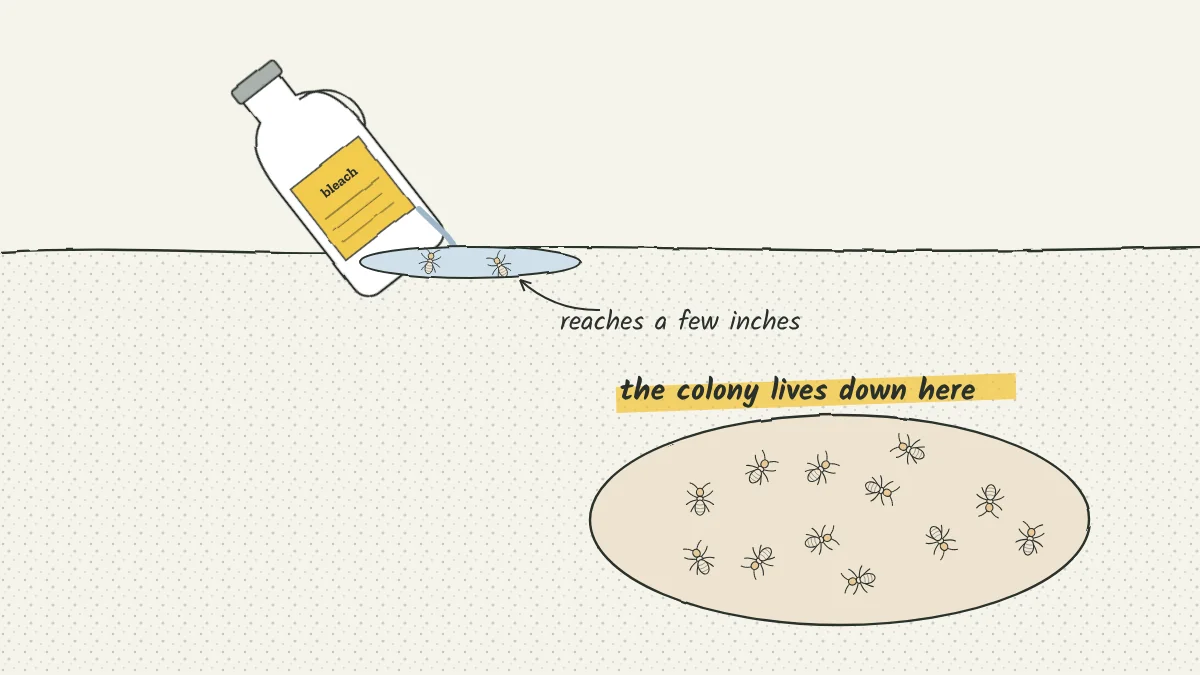
The short version
Bleach can kill termites it soaks directly, but it won't get rid of an infestation. The colony lives in the soil or deep inside wood, out of reach, and bleach leaves nothing behind once it dries or soaks away. No extension service recommends it, and mixing bleach with other cleaners can release toxic gas. Get the termites identified and inspected instead.
On this page
What bleach actually does to termites
Termites are small, soft-bodied insects. Workers in particular are pale, thin-skinned and need moisture to survive. Soak one in household bleach and it will very likely die, along with most other insects you could drown in a harsh chemical.
That's the whole list of what bleach does. It's a contact killer with no reach and no staying power. Once it dries, evaporates or soaks into the soil, it's done.
A termite problem isn't the termites you can see. It's the colony feeding them.
Why the colony doesn't care
These numbers, from university extension entomologists, show the scale you're up against with a bottle of anything.
| Fact about the colony | What it means for bleach |
|---|---|
| Average mature colony: about 300,000 termites (NC State) | You might hit a few dozen |
| Workers forage up to 200 feet from the nest (NC State) | The nest may not even be under your house |
| Termites usually stay in the top 4 to 6 inches of soil, in tunnels (Texas A&M) | A puddle doesn't spread through their galleries |
| Colonies replace lost breeders with secondary reproductives (NC State) | Even a lucky hit on the royal pair wouldn't end it |
| Drywood colonies live sealed inside the wood (Texas A&M) | Liquid poured on the surface never gets in |
More on how colonies are organized, and why that matters for treatment, in what does a termite king do.
Isn't it worth a try anyway?
I get the appeal. It's cheap, it's under the sink, and it makes you feel like you did something. But it costs you something real: time.
Every week spent on home remedies is a week the colony keeps eating. Worse, breaking open and soaking mud tubes can make an inspector's job harder, because those tubes are the evidence that shows where termites are getting in and whether they're still active. Leave them alone, take photos, and let a professional see them as they are. Our guide to termite mud tubes explains what they tell an inspector.
And there's a legal footnote. Bleach isn't labeled as a termite treatment. Pesticide labels in the U.S. are the law, and the products that are labeled and proven for termites are a different shelf entirely.
Other home remedies, honestly
Bleach has company. Here's how the usual suspects stack up.
| Remedy | What it can do | The catch |
|---|---|---|
| Bleach | Kills termites it soaks | No reach, no residual, toxic gas if mixed |
| Vinegar | Same story, contact only | Same reach problem. Never mix with bleach |
| Boiling water | Kills what it hits | Cools within inches and can kill your plants |
| Dish soap spray | Can kill exposed termites | Only the ones you see |
| Borate wood treatments | Help protect bare wood from future termites, per the EPA and Texas A&M | Texas A&M says borates won't kill termites already deep inside timbers. See boric acid for termites |
| Orange oil | A real spot treatment for drywood termites, used by professionals | Only treats the board it's injected into. See orange oil treatment |
| Beneficial nematodes | The EPA says they've shown some success, mainly in the lab | Not a fix for an active infestation. See nematodes for termites |
For a closer look
As an Amazon Associate I earn from qualifying purchases.
-
View on Amazon
Bright LED flashlight, 1,000+ lumens
The one tool that really matters. A tight, bright beam shows mud tube texture and wing piles in dark corners.
-
10x magnifying loupe
Tells a six-sided drywood pellet from sawdust, and a termite wing from an ant wing.
What to do instead
-
Make sure it's termites
Flying ants and termites swarm at the same time of year and fool everyone. Take a clear photo or catch a few in a jar. Texas A&M suggests putting specimens in rubbing alcohol if you want them identified. Our termite or flying ant quiz takes about thirty seconds.
-
If they're swarming indoors, vacuum them up
Swarmers are trying to get outside, and the ones trapped indoors don't last long without soil and moisture. A vacuum is faster and safer than any spray. Then read termites swarming in the house, because the swarm tells you a colony is nearby.
-
Leave the evidence alone
Don't break, soak or scrape mud tubes, and don't tear into damaged wood. Photograph everything and note where it is.
-
Get two or three licensed inspections
The EPA suggests getting bids from two or three companies and checking that each is licensed by your state. See how to choose a termite company and what a fair price looks like in termite treatment costs.
-
Pick a treatment that reaches the colony
For subterranean termites that means a non-repellent soil treatment or a bait system that workers carry back. For drywood termites it means fumigation, heat or targeted wood treatments. The treatment options guide compares them side by side.
Questions people ask
Does bleach kill termites instantly?
It can kill termites it soaks directly within a short time, like many harsh liquids. It does nothing to the colony in the soil or inside the wood, so the termites you see are quickly replaced.
Can I spray bleach on mud tubes?
You can, but it won't solve anything and it destroys evidence an inspector needs. Leave mud tubes intact, photograph them, and have a licensed inspector look at them.
Does vinegar or bleach work better on termites?
Neither works as a termite treatment. Both only kill what they touch. Never mix them, because bleach and acids like vinegar release chlorine gas.
What kills termites permanently?
Nothing is permanent, but professional treatments get closest: non-repellent liquid soil treatments typically protect for about five years or more, and bait systems keep working as long as they're monitored. Prevention habits help either one last.
Will bleach keep termites away?
No. Bleach breaks down and leaves no lasting protection. Keeping wood away from soil and the foundation dry does far more to keep termites away.
Keep reading
Termites in your state
Sources
- NC State Extension: Biology and behavior of eastern subterranean termites
- Texas A&M AgriLife Extension: Subterranean termites (E-368)
- Texas A&M AgriLife Extension: Drywood termites (E-366)
- National Capital Poison Center: Chlorine gas
- U.S. EPA: Termites, how to identify and control them
- University of California IPM: Pest Notes, Termites