What Does a Termite King Do? How a Termite Colony Works
Ant and bee colonies are run by a queen alone. Termite colonies have a king too, and he sticks around for years. Here's what he does, and why it matters for how termites get killed.
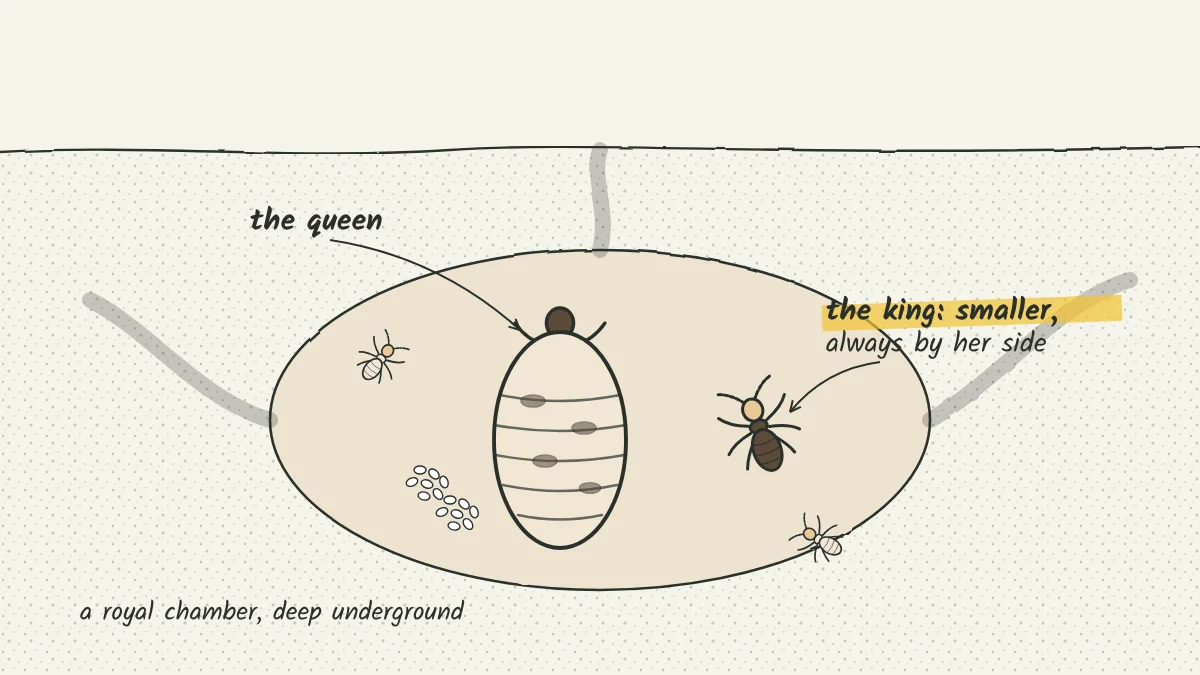
The short version
A termite king is the colony's founding male. He and the queen start the colony together after a swarm flight, and unlike male ants or bees he doesn't die after mating. He stays with the queen for life, mating with her again and again so she keeps laying eggs. Kings can live a decade or more.
On this page
The king's job, in one sentence
He's the colony's other parent, and he keeps showing up for work.
In ants, bees and wasps, males mate during a nuptial flight and die soon after. The queen stores the sperm and runs the colony alone. Termites do it differently. After the swarm flight, a male and a female shed their wings, pair up and dig a small chamber together. They become the king and queen, and NC State University's extension entomologists point out that termites are unusual among social insects for having both.
From then on, the king's job is simple and repetitive. He mates with the queen periodically for as long as they both live, which keeps her egg production going. In the first months, before there are any workers, the royal pair also does the chores themselves: feeding and tending the first small batch of young.
Who does what in a termite colony
A colony is a family business with a strict division of labor. Here's the org chart.
| Caste | What they look like | What they do |
|---|---|---|
| King | Dark-bodied, wingless, about the size of a swarmer | Co-founds the colony, mates with the queen for life |
| Queen | Starts like the king, then her abdomen swells over the years | Lays the eggs. Thousands a year in a mature colony |
| Workers | Small, soft, creamy white, blind | Everything else: foraging, eating wood, building tubes, feeding everyone, caring for eggs |
| Soldiers | Like workers, with a large brown head and big jaws | Guard tunnels and fight ants. They can't feed themselves |
| Swarmers (alates) | Dark bodies, two pairs of equal-length wings | Fly out once a year to become the next kings and queens |
| Secondary reproductives | Pale, sometimes with wing buds | Back-up breeders that take over or add to egg-laying |
King vs. queen
The king and queen start out looking almost identical, because they were both swarmers a few hours earlier. Then the queen changes and the king mostly doesn't.
Over the years her abdomen stretches as her ovaries develop, and in some species she becomes many times larger than the workers around her. The University of California's Integrated Pest Management program describes the queen as the largest individual in the colony, able to lay thousands of eggs in a single day in some species, with the king always by her side. NC State notes that the king is significantly smaller than the queen and never gets the enlarged body.
In our common eastern subterranean termite the numbers are more modest. Virginia Tech describes a mature queen of about 14.5 millimeters, a bit over half an inch, producing more than 500 offspring a year, and NC State puts a typical queen at 5,000 to 10,000 eggs a year. Either way, she's no match for the giant queens in nature documentaries. Those are tropical mound-building termites, not the ones under your porch.
How fast a colony grows
The royal pair starts small and slow. These are the milestones extension researchers describe.
| Stage | Colony size | Source |
|---|---|---|
| First year | About 75 termites | UC IPM |
| Mature, 3 to 5 years | About 250,000 workers is typical | Texas A&M AgriLife |
| Average mature colony | About 300,000, some reach millions | NC State Extension |
| Formosan, within 5 years | More than 1 million | Texas A&M AgriLife |
Numbers vary with species, climate and food. A colony of the size Virginia Tech describes for Virginia, around 60,000 workers, can eat roughly a foot of 2x4 in about five months, by NC State's estimate.
How long a termite king lives
Kings and queens are the long-lived members of the colony. Workers are the ones that turn over constantly.
Virginia Tech's extension entomologists write that the parent king and queen often survive a decade or longer, and UC IPM says kings and queens can live a decade or more. NC State goes further and says primary reproductives sometimes survive for decades. That's a long time for an insect, and it's one reason colonies under old houses can be older than the people living in them.
Why the king matters to your house
You'll never see the king. He lives deep in the colony's galleries, often underground and some distance from the wood being eaten. Subterranean workers can forage as far as 200 feet from the nest, according to NC State, so the damage in your door frame tells you very little about where the royal chamber is.
What the king does tell you is something about treatment. Because the colony can always make new breeders, the treatments that work best are the ones that reach lots of workers, who then carry it back through the colony:
- Bait systems use slow-acting insect growth regulators that workers eat and share. UC IPM describes them as able to suppress or eliminate a whole colony. More in termite bait stations.
- Non-repellent liquid termiticides don't scare termites away, so foraging workers keep walking into treated soil. See liquid termite treatment and our Termidor SC review.
- Drywood colonies live inside the wood itself, king and all, so tenting or heat can reach them directly. See drywood termites.
Where new kings come from
Every spring, mature colonies raise winged swarmers. The swarm is the colony's way of making new kings and queens, and it's also the moment homeowners are most likely to notice termites at all.
NC State says a queen can take as long as a decade before her colony produces its first swarmers. So a swarm inside your house usually means a colony that's been established for years, not one that moved in last week. UC IPM adds that most new kings and queens land within about 100 meters of the colony they left, which is why a swarm on your windowsill is worth an inspection even if the swarmers came from the yard. Shed wings are the classic leftover.
Most pairs never make it. Birds, ants and dry pavement see to that. The ones that survive spend their first year raising a family of a few dozen. Kings, it turns out, play a very long game.
Questions people ask
Does a termite king do anything besides mate?
Early on, yes. The founding pair digs the first chamber and cares for the first eggs and young until there are workers to take over. After that, his main job is mating with the queen periodically for the rest of his life, which keeps the colony's egg supply going.
How big is a termite king?
About the size of a swarmer, minus the wings. In native subterranean termites that's around 3/8 inch long. Unlike the queen, his body doesn't swell as the colony grows, so he stays small and dark-bodied.
Can a termite colony survive without a king?
Yes. If the king or queen dies, workers or nymphs can develop into secondary reproductives that take over breeding. That's why killing the founders isn't how termites are controlled.
How long does a termite king live?
Extension entomologists at Virginia Tech and the University of California say kings and queens often live a decade or more. NC State says primary reproductives sometimes survive for decades, far longer than workers.
Do all termites have a king?
Every colony is founded by a king and queen, whether subterranean, drywood or dampwood. Large colonies may also have many secondary reproductives working alongside or instead of the original pair.
Keep reading
Termites in your state
Sources
- NC State Extension: Biology and behavior of eastern subterranean termites
- University of California IPM: Pest Notes, Termites
- Virginia Cooperative Extension: Subterranean termite biology and behavior (444-502), Dini M. Miller
- Texas A&M AgriLife Extension: Subterranean termites (E-368)
- Texas A&M AgriLife Extension: Formosan subterranean termites (E-367)