Termite Droppings but No Termites? What It Means and What to Do
Little piles of "pepper" and not a bug in sight is exactly what drywood termites look like. Here's how to read the pile, test whether anyone's still home, and decide what to do.
The short version
Termite droppings with no termites in sight almost always mean drywood termites living inside the wood above the pile. They never leave it, so you won't see them. Sweep the pellets up, check the same spot in one to two weeks, and if fresh pellets appear, the colony is active. Get a licensed inspector to confirm it.
On this page
Why you see the droppings but never the termites
Most of us picture termites as the soil-dwelling kind that build mud tubes up a foundation. Those are subterranean termites, and they don't leave pellet piles at all. They use their droppings as building material inside their tunnels.
Drywood termites live differently. The whole colony lives inside one piece of wood, or a few connected ones: a window frame, a rafter, a door jamb, an old dresser. They get the water they need from the wood and the air, so they never come out to the soil.
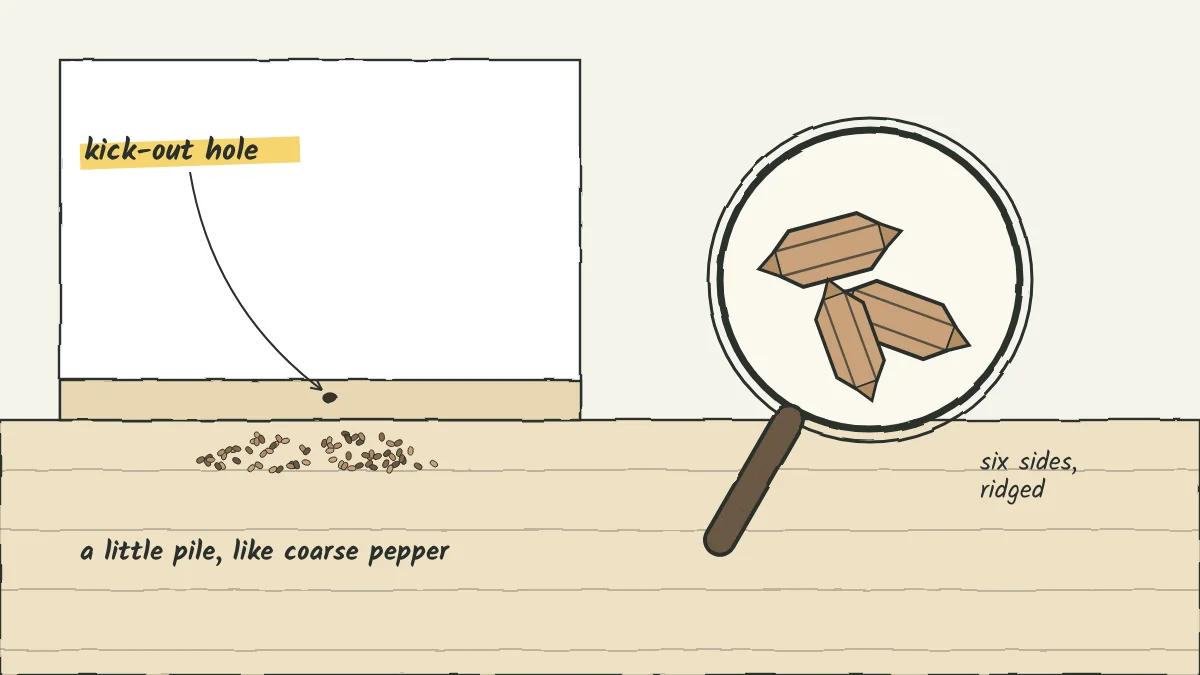
Their waste is hard, dry pellets. A clean nest matters to them, so workers chew a tiny opening in the wood surface, push the pellets out, and seal the hole again. That opening is called a kick-out hole, and it's less than 2 millimeters across. The pellets fall and pile up on whatever is below: a windowsill, the floor, the top of a cabinet.
So the pile is the only sign of them you'll usually get. The termites stay inside, a few inches from where you're standing.
Is it really termite droppings?
A few other things leave little piles. Here's how to tell them apart without a lab. A cheap 10x loupe makes this a lot easier.
| What you found | What it looks like up close | What it means |
|---|---|---|
| Drywood termite pellets | Hard, gritty, all about the same size, smaller than a grain of rice. Six sides with ridges running lengthwise | Drywood termites in the wood above |
| Dampwood termite pellets | Rounded at both ends, like tiny footballs, without clear ridges | Dampwood termites in wet, rotting wood |
| Carpenter ant debris | Soft, fluffy, shredded wood fibers, often mixed with insect parts | Carpenter ants hollowing out damp wood. See carpenter ants vs termites |
| Sawdust | Stringy, uneven bits that crush flat between your fingers | Someone drilled or sanded nearby, or powderpost beetles if it's very fine flour |
| Mouse droppings | Much bigger, dark, pointed at the ends | Mice, which is its own problem |
Color doesn't help much. Drywood pellets range from light tan to almost black, and the color doesn't reliably match the wood they came from.
Pellet detective kit
As an Amazon Associate I earn from qualifying purchases.
-
10x magnifying loupe
Tells a six-sided drywood pellet from sawdust, and a termite wing from an ant wing.
-
View on Amazon
Bright LED flashlight, 1,000+ lumens
The one tool that really matters. A tight, bright beam shows mud tube texture and wing piles in dark corners.
-
View on Amazon
Awl or flat-head screwdriver
Press it into suspect wood. Healthy wood fights back. Eaten wood gives way like a stale cracker.
Old pile or active colony?
Here's the honest part. A pile of pellets alone can't tell you whether the infestation is still active. Pellets don't rot, and an old pile can sit in a wall void or an attic for years. Plenty of homeowners find pellets left behind by a colony that was treated before they bought the house.
So you test it. It takes two weeks and costs nothing.
The two-week sweep test
-
Photograph the pile where it lies
Take a wide shot and a close-up with a coin for scale. If an inspector comes later, this saves a lot of guessing.
-
Find the hole above it
Look straight up from the pile with a bright flashlight held at a low angle to the surface. Kick-out holes are tiny and often painted over or plugged. Joints, cracks and the edges of trim are the usual spots.
-
Clean it up completely
Sweep or vacuum every pellet. Then lay a sheet of white paper or a strip of painter's tape on the surface under the hole, so new pellets are easy to see.
-
Check again in one to two weeks
Fresh pellets on the paper mean the colony is active and working right now. No new pellets is good news, but not a clean bill of health. Colonies slow down in cool weather, so check again in a month.
Where else the pellets might be coming from
If there's no hole in the wood right above the pile, look higher and wider. Pellets travel.
- The attic. Pellets can trickle down through gaps around ceiling lights, vents and the top of interior walls. A pile on top of a cabinet often comes from the ceiling.
- Window and door frames. The most common spot in Florida and Southern California homes, because the trim is right there and nobody inspects it.
- Furniture. Drywood termites happily live in wooden furniture, picture frames and antiques. A pile under a dresser and nowhere else is worth a close look at the dresser.
- Wall voids. Pellets can collect inside a wall and only show up when they spill out of an outlet or a baseboard gap.
When drywood termites give themselves away
Drywood termites also swarm, and the shed wings on a windowsill are often the second clue people notice after the pellets. Timing depends on the species and where you live.
| Termite | J | F | M | A | M | J | J | A | S | O | N | D |
|---|---|---|---|---|---|---|---|---|---|---|---|---|
| West Indian drywood Night, toward lights | common | peak | common | |||||||||
| Western drywood Warm, sunny afternoons | some swarms | peak | peak | some swarms |
Found pellets? Do this, not that
Do
- Photograph the pile and save a few pellets in a zip bag
- Do the two-week sweep test before you call anyone
- Check furniture and the attic, not just the trim
- Get at least two inspections if someone recommends tenting
- Ask whether a local treatment would do the job
Don't
- Spray bug spray into the hole. It won't reach the colony
- Seal every hole with caulk and call it fixed
- Panic about the whole house from one pile
- Throw out a valuable antique before someone confirms it's active
What happens if it's active
Treatment depends on how widespread the colony is, and it's worth pushing back on anyone who skips that question.
One colony in one piece of wood can often be handled locally: an injected termiticide or foam, heat on that spot, or simply replacing the board. This is cheaper and you don't have to leave home.
Several colonies, or ones you can't reach, usually call for treating the whole structure, either by fumigation (termite tenting) or whole-house heat. Both kill every drywood termite in the house on the day, and both leave no lasting protection behind, so new swarmers can move in later.
The details, including when local treatment is enough, are in drywood termite treatment. For price ranges, see how termite treatment prices work.
Questions people ask
What do termite droppings look like?
Drywood termite droppings are tiny, hard pellets, smaller than a grain of rice, with six flat sides and ridges along their length. In a pile they look like coarse ground pepper or fine sand, in colors from tan to nearly black.
Can you have termite droppings and no termites?
Yes. The pellets can be left over from a colony that died or was treated years ago, because pellets don't break down. The only way to know is to clean them up and see whether new ones appear within a couple of weeks.
Do subterranean termites leave droppings?
Not in piles. Subterranean termites mix their waste into the mud of their tubes and tunnels. If you're finding pellet piles, you're almost certainly dealing with drywood termites, or with something other than termites.
Are termite droppings harmful to people?
There's no evidence that drywood termite pellets carry disease. They're digested wood. Sweep them up, and treat them like any household dust if you have allergies.
How long does it take to see new termite droppings after cleaning?
In warm weather an active colony usually shows new pellets within one to two weeks. In cooler months it can take longer, so a quiet two weeks in January isn't proof that the colony is gone.